


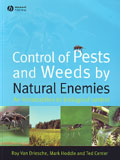
| Title: Control of Pests and Weeds by Natural Enemies: an introduction to biological control | |
| Author(s): Roy Van Driesche, Mark Hoddle and Ted Center | |
| Date of Publication: 2008 | Publisher: Blackwell Publishing |
| Pages: x + 473 | ISBN: 978 1 4051 4571 8 |
| Price: | Format:Paperback |
| Target Readership | Educator | ||||
| Presentation/Style |  |
|
|
 |
|
| Content | |
|
|
|
|
| Literature | |
|
|
|
|
| Originality | |
|
|
|
|
| Overall | |
|
|
|
|
|
Content:
1 – Scope of biological control; 2- Kinds of natural
enemies; 3 - Invasions: why biological control is needed; 4 -
Natural enemy introductions - theory and practice; 5 - Tools for
classical biological control; 6 - Safety; 7 - Measuring natural
enemy impacts on pests; 8 - Conserving biological control agents
in crops; 9 - Biopesticides; 10 - Augumentative biological control;
11 -Other targets and new directions. |
|
Review: One of the many problems facing ecosystems today is the fact that old bioregions/realms are breaking down due to transportation of species. This has reached serious proportions in many parts of the world. The next move should be to find some way of stopping the invasive species without destroying the original ecosystem. One promising method is to use a natural predator to control the species. This is easier said than done (especially writing from Australia which has a truly horrendous record of transportation of species!). Not only do you have to find a good control agent it mustn't become a pest in its own right (the cane toad is instructive here). Of course this is just the start of the problems which is where this text comes in. Seeing a need for biological control it aims to provide a detailed overview of the subject - hopefully to provide examples of good practice. It's linked to a website, which contains a range of excellent resources (if a little US-centric). The text's 29 chapters are divided into 11 parts. The first part is very brief, just permitting an overview of some key terms and ideas. Since this is a book focussing on pest control, part two gives an overview of the kinds of control agents that might be found useful ranging from parasites to insects. Part three considers a topic one might have expected earlier - the reasons why control is needed. Pests do more than economic harm, they can alter ecosystem functioning and create other issues. As a side note it's interesting to see recent reports that invasive species might have some benefits e.g. providing more biodiversity, but the aim here is to stress the need for the 'original' ecosystem. Part four focusses on one case of contro referred to as 'classical' control. Although not formally defined the idea is to use ecological principles against the pest species and this part certainly elaborates on this area. Allied to this is part five which outlines the methods available for pest control from collecting the 'predators' to checking physical conditions. Part six recognises that not all biological control has been successful. Mistakes have often happened and often created a worse problem than the one it is intended to solve. The trick is to target a selected host in a given range with an agent that is specific (although we are reminded that this isn't always acheived in practice). Part seven follows up with the ideas needed to check if an agent is working (cost) effectively. This notion of effectiveness is carried over into part 8 which discusses reasonable measures of success. Biological control is valuable but not always the best idea - pesticides still work. Part 9 moves on to look at more recent advances in using pathogens as pesticides whereas part 10 sees the control agent as an addition i.e. an extra to be used in certain situations e.g. glasshouse production. Finally, part 11 highlights some of the future directions for this area. A very extensive bibliography completes the text. Although this is aimed at those with a good background in the subject it can have wider appeal. Chapters are very brief and crammed with ideas, data, examples etc. which make it very reabable. It contains a wealth of detail which can be used to structure a more reasoned response to biological control (unlike, for example, that seem with the GM debate). |