


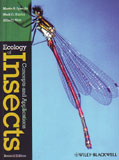
| Title: Ecology of Insects - Concepts and Applications. 2e | |
| Author(s): Martin R Speight, Mark D Hunter and Allan D Watt | |
| Date of Publication: 2008 | Publisher: Wiley-Blackwell |
| Pages: vii + 628 | ISBN: 978 1 4051 3114 8 |
| Price: | Format:Paperback |
| Target Readership | |||||
| Presentation/Style |  |
|
|
 |
|
| Content | |
|
|
|
|
| Literature | |
|
|
|
|
| Originality | |
|
|
|
|
| Overall | |
|
|
|
|
|
Content:
1 – An overview of insect ecology; 2 - Insects
and climate; 3 - Insect herbivores; 4 - Resource limitation; 5
- Natural enemies and insect population dynamics; 6 - Evolutionary
ecology; 7 - Physiological ecology; 8 - Insects in ecosystems;
9 - Biodiversity; 10 - Insect conservation; 11 - Insects and diseases;
12 - Insect pest management. |
|
Review: Insects are one of the most important classes of species and certainly one of the most widespread. Their value in ecosystem services is well acknowledged. They are also (mostly) suitable species to study and for this reason, much student fieldwork can involve insect ecology. This does not mean that they are any easier to study than other organisms but they are certainly popular. This text, now in its second edition, aims to demonstrate the key features of insects. We start with an overview of ecology looking at key ideas such as evolution, basic ecology and interaction with people. Chapter two outlines the impact climate has on insects - a topic much in the news of late in terms of pest species spread under global warming. Chapter three examines herbivory from both sides - insect and plant defences and shows how molecular genetics can aid our understanding. This qualitative view gives way to two chapters on limitations for insects. The first involves the ways in which resources can limit population whilst the second shows how predators can achieve the same thing. Both are important because the population dynamics of insects would otherwise facilitate rapid population development. One of the responses to these limitations is to adapt or evolve to reduce the impact of limits. Chapter six looks at some of the ways evolution works from life strategies to reproductive strategies and symbioses. As has been noted, insects are some of the most successful species with the widest geographical spread. It follows that there must be mechanisms that allow this to work and chapter seven outlines some of the key physiological ones. Feeding mechanisms, metabolism and pupation are described and although this list is by no means complete there are strong indications of how successful this class is. Up to this point the focus has been on the insect species and far less on interactions. Chapter 8 starts the move towards a more inclusive ecology by examining the role of insects in ecosystems as predators, prey and even invasive species. Chapter 9 turns to the question of biodiversity. Starting with a broad outline of biodiversity the chapter focusses in on key aspects such as key hotspots for insects and the roles insects play. Given their range and importance, conservation is also a key issue. There is a tendency for people to consider insects as being extinction proof by virtue of their large numbers but this is not the case. This is significant because many ecosystems rely on insects and the loss of species can be far more crucial than just numbers might suggest. Having spent two chapters on keeping insects, the last two focus on why we need to remove them. Leaving aside the philosophical issues this raises, insects are major disease vectors and, as chapter 11 describes, there is much we need to do to control this. Finally we consider the notion of insect as pest and what we can do to control it. Both are key areas and this is highlighted by the fact that both chapters are substantial. For those wishing to follow up any reference there are a substantial 80 pages to look through. Although specialised there is much to like about this book. It covers all key areas of insect ecology and uses a wide range of examples in terms of both species and geographical area. The text is extremely well illustrated. Insects are crucial to many aspects of our lives. They are also a fascinating class to study. Putting these together suggests that this text is ideally placed to capitalise on such interest. |