


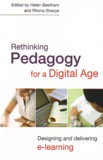
| Title: Rethinking Pedagogy for a Digital Age | |
| Author(s): Helen Beetham and Rhona Sharpe (eds) | |
| Date of Publication: 2007 | Publisher: Routledge |
| Pages:xiv + 260 | ISBN: 978 0 415 40874 5 |
| Price: | Format:Paperback |
| Target Readership | Educator | ||||
| Presentation/Style |  |
|
|
 |
|
| Content | |
|
|
|
|
| Literature | |
|
|
|
|
| Originality | |
|
|
|
|
| Overall | |
|
|
|
|
|
Content:
1 – Learning and e-learning: the role of theory;
2 - An approach to learning activity design; 3 - Designing courses
for e-learning; 4 - Practices and processes of design for learning;
5 - Describing ICT-based learning designs that promote quality
learning outcomes; 6 - Describing learning activities: tools and
resources to guide practice; 7 - Representing practitioner experiences
through learning design and patterns; 8 - Learning design systems:
current and future developments; 9 - Supporting practitioners'
design for learning: principles of effective resources and interventions;
10 - The use of scenarios in designing and delivering e-learning
systems; 11 - The art of design; 12 - Discipline-based designs
for learning: the example of professional and vocational education;
13 - Designing for practice: practicing design in the social sciences;
14 - Designing for mobile and wireless learning; 15 - Building
communities of designers; 16 - New horizons in learning design;
Appendices - Resources. |
|
Review: The inclusion of educational texts into an ecological site might at first raise some eyebrows until we realise that part of the work (and the existence of this site) is all due to some form of online learning. There is such a wave of quality resources at the moment it has been decided to broaden the scope of these reviews to help ecological and environmental educators find out how to better communicate their interests. This is no minor point: the volume of material passing this desk (and it's only a fraction of the total) is such that something needs to be done to make it stand out. If we translate this into the wider world of learning then it follows that we must compete effectively with other resources to get our message across. Thus, for the ICT adopters amongst the ecological community, here's a text on the basics of the new ideas in e-learning (see also JISC, LAMS and HE Academy for an idea of what some of the contributors are involved in). The text is divided into three main areas. After an introduction which focusses the reader on the main ideas, the first part looks at models of learning. It is clear from the outset that this is not a book on how to replace teachers (or teaching) or an ICT-based panacea but a reasoned approach to alternative methods of reaching the best education for the students. Although the students here are primarily in higher education there is no reason to believe that similar couldn't be used in a school setting. We open with a look at the theory of learning and the three key approaches - associative, cognitive and situationist. Along with this there's a very brief look at the role of e-learning here. Chapter two moves on to design. This is a key activity in this branch of e-learning because the aim is to get a quality resource that is both useable and re-useable (in that design elements can be separated from content and used by others if seen to be successful). The next two chapters mirror the same theme highlighting the importance of this element to e-learning. Interestingly, some aspects described here look suspiciously like beginner-teacher's lessons notes! Perhaps the idea to get across is that careful design is like a good lesson plan - you know what's happening at each minute and the outcome should be favourable. It's also worth the reader reflecting on the principles being highlighted e.g. e-learning is not a quick fix done in a lunch break but a far longer term commitment. Chapter five puts design to the test to show how different pedagogies (chapter 1) would alter the design (chapters 2-4). Having all this design doesn't make for a great outcome. As we are reminded in both chapters six and seven, it requires a deep understanding of the potentials and pitfalls in e-learning two of which are getting others to understand what you've done and how you communicate this to them. Chapter 8 wraps up the section with a foray into some future developments. Part two gets to the sharp end of the business by putting together the context-neutral world of theory with the highly contextualised world of the subject teacher. It is clear that we need to learn from theory but we also need to put our own special mark on the work because it is in the authenticity of context that the student will gain motivation to try the work. Chapter in this section do not so readily follow a pattern but provide a discourse through settings. Thus chapter 9 opens with an invitation to consider the professional teacher in all of this an make sure s/he is supported. From here, we are taken through a series of projects and ideas (not all perfectly formed) in different subjects. There's a look at the use of scenario building and the value of multimedia in art. Legal and medical subjects need their own specific vocational requirements. Finally, in chapter 13 social studies gets its chance to outline the parameters it needs to address. The next two chapters move away from subject to type of learner with work on wireless technology and designer communities. A final chapter looks into the future like its part one counterpart. A series of appendices give an extremely useful set of tables outlining a range of key issues for e-learning and therefore a start to those outside the institutions mentioned wishing to start. This is an extremely interesting text. It comes at a time when the e-learning debate is reaching centre stage and there is a need to put this information into wider circulation. Chapters are detailed enough to provide a depth of information and brief enough to allow an overview (with usually excellent references to follow up detailed ideas). This gives the reader a wider scope than is seen in many texts in this field. As such it should be seen as an essential primer in the field and required reading in educational training (and providing!) institutions. |